

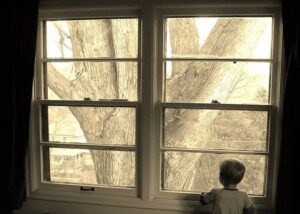
Facebook wants to know if I’d like to share a memory, offering up a photo I took in November of 2009. In the center of the image, the trunk and spreading branches of a giant silver maple are framed in two windows, and in the foreground stands my toddler, looking out at the tree. I almost don’t bother to share it, but then I do, because I think about how he was our baby, the littlest, and now he’s in high school, the tallest in the family. I think about how looking at the picture makes me feel that I could easily go back to that house, walk into that room, and he would be there, with his little blond head, and the tree would be there, massive and stalwart, and I could simply pick up my life from that moment. When I share the picture, I write, “Time is so strange,” which gets at only a fraction of what I mean.
When our realtor brought us to that Omaha house in late spring of 2009, I noticed the tree first, and for me, it clinched the deal. The tree grew in the backyard, so all I could see of it from the street was a riotous green crown spreading luxuriantly above the roof of a spacious stone ranch house, but it arrested my attention. In the fractured logic of my grieving, my thoughts leapt erratically, latching onto one fixation, then another. My grief seemed to be nothing more than a desperate search for tangible symbols, real objects on which to affix itself, so that it could be contained, rendered meaningful. I took one look at that tree and thought: Here. I am moving here. I am putting all of my sadness into that tree. I have rarely known anything with such certainty.
Fortunately, the house had other things going for it. My husband Doug admired its stone exterior and sound construction, and my toddler and preschooler ran through its empty rooms, marveling at so much space, after four months of apartment living. The location, too, was excellent. It sat in the middle of a long block of well-loved homes, many of them spacious ranches built in the late 1940s and early 1950s, set far back from the street, green lawns unfurling, mature oaks and maples gracing their large yards where children climbed on playscapes. On our side of the street, the backyards sloped away from the houses, the land rambling over some hills in its slow descent to the Missouri River and Iowa border about five miles to the east. This topography gave us a walk-out basement and a terraced backyard, and it was on the top terrace, tucked too close against the house, that our silver maple grew.
We bought the house a month after my grandmother died in California. I cannot express this loss but in the simplest terms: she was, in my early childhood, my best friend in the whole world. And though I had left California nearly a decade ago, she had followed my doings—college degrees, kids, moves to places she would never see—with pride and delight. And now she was gone, and I had a tree.
I don’t remember meeting Virginia, our neighbor to the north. I did not at first form much of an impression of her, beyond that she was elderly, lived alone, seemed friendly enough. Clustered around us were three families who each had three children between the ages of one and six. Once we moved in, eleven kids spilled out across five yards, including Virginia’s, but she smiled at the hubbub and waved at the children careening across her lawn. She didn’t seem to mind being sandwiched between four young families.
To our south lived three girls who became my kids’ primary playmates. I often found myself chatting with their mom, Rachel, as we supervised our kids, but we were too harried to become more than acquaintances. Our attention was always elsewhere—keeping our toddlers out of the road, adjudicating squabbles between the preschoolers.
In mid-August, the older kids went back to school, Doug started working longer days, and suddenly I found myself filling long hours with my toddler. One day, after dropping my preschooler off at school, I took the toddler outside to pull some of the weeds that had sprung up in the ferns that grew alongside our house. Suddenly, Virginia appeared, wearing floral gardening gloves and armed with an array of gardening tools. “I thought I’d offer you a hand,” she said, and then she got down on her knees and began to work alongside us. We talked as we worked—she told me about the neighborhood, I told her about our many moves—and when we finished for the day, she said, “I have a feeling you and this little boy are quiet and serious together all day long.” It was true—when the loquacious preschooler wasn’t around, we tended to lapse into periods of silence. “I’m going to take the two of you out to lunch,” she concluded. “Does next Tuesday work?” Next Tuesday worked, and the one after, and the one after. Pretty much any Tuesday of my life as far out as I could see would work. We made a plan. That night, I wrote: We weeded past lunchtime with Virginia. She is astute.
Every day of that summer and fall, I went outside and leaned against the trunk of that silver maple, feeling the miraculous bulk of its being, and it seemed to absorb the waves of sadness that came off of me. The children often came with me, and they, too, leaned on the tree, not understanding why, but absorbing the lessons of stillness and sadness that I was teaching them through example. Sometimes I would see Virginia raking or pruning in her backyard, which was separated from ours by only a low chain-link fence, and she would see me and wave, but she never interrupted me, never asked me what I was doing, why I needed to spend so much of my time being supported by a tree.
On our first outing, we went to Tuesday Morning, Virginia’s favorite bargain store. She pushed the toddler in the shopping cart, showing him everything. She insisted that he pick out gifts. He selected a purple plaid flannel shirt for himself, a pirate figurine for his sister who was at school. Virginia wanted to buy me a gift as well, but I declined. As she wheeled the cart around the store, following the toddler’s pointing finger, she kept leaning over to kiss him on the head, making him shiver with delight. They were smitten with one another.
We headed to Panera, where Virginia told me her life story over lunch. “I was born in 1921,” she began. “I’m eighty-eight years old.”
I stared at her. “My grandmother was born in 1921,” I said, and then I didn’t say anything more. It was the only time I ever mentioned my grandmother to Virginia. The conversation moved on.
I learned that Virginia was an only child who had lived her whole life with her parents until first her mother died, in 1966, and then her father, in 1978. I learned that she was active in her church, had a wide circle of friends, still drove. She had worked at the same company as her father—an accounting or finance firm—but I don’t remember the details. She asked about my work, but I only told her that I was ABD—all but dissertation—and then I changed the subject.
The toddler occasionally added to the conversation, interjecting a loud “strawberry!” to express his continued amazement at the unlikely appearance of strawberries in a salad.
Later that afternoon, the preschooler wrote a note—THANK YOU FOR THE PIRATE VIRGINIA XX OO—and left it on Virginia’s porch when she didn’t answer her door. Half an hour later, Virginia was back at our door, excitedly waving the note. “I didn’t come to the door right away because I was on the telephone with my friend telling her all about the wonderful time we had today!” she exclaimed. And so our friendship began.
A college student named Cassie started coming a few hours each week to watch the toddler while the preschooler was in school. I would then go to the basement to work on my dissertation—or so I said, because it seemed like a legitimate thing to be doing in the basement while paying a babysitter to care for my child. The babysitter had been Doug’s idea. He thought I needed time to do my own work—a break from unrelenting parenthood to write or even just to think. The truth was, I had finished my dissertation over a year ago, and I was postponing my defense, biding my time. If I defended, my PhD would be complete, and then I would have to do the next thing. I didn’t know what the next thing was. Right now, the next thing was being home with kids and sitting with a tree and hanging out with Virginia. The truth was, when I went to the basement to work on my dissertation, sometimes I secretly wrote essays about trees—which had nothing to do with my dissertation. The silver maple grew right outside my basement study, so sometimes, when I was certain Cassie had taken the toddler out in the stroller, I would sneak out the back door and sit with the tree, hoping she didn’t return early and bring him down to the backyard, where she would discover my secret: working on my dissertation meant sitting with a tree.
In September, the preschooler started bringing Virginia home-baked treats: a warm blueberry muffin, a slice of poppyseed cake. “It’s the sort of thing neighbors used to do but don’t anymore,” Virginia said in approval. The truth was, we started baking because I decided to ship treats to my uncle in California, once a month for an entire year, with the first mailing commemorating his sixtieth birthday in September. My uncle had lived with my grandmother in the thirteen years of her widowhood, had become her caretaker at the end, and was now alone. Our treat-of-the-month club was a bridge between now and a future we couldn’t imagine, a time when we no longer needed trees or cookies to get us through. Virginia didn’t know she was the beneficiary of our treat-of-the-month club, that it had two members who had not subscribed but were chosen, who were not aware of one another but were connected in my project of grief.
The next time we went out to lunch, the preschooler joined us while the toddler stayed home with Doug. As always, Virginia showed up at the appointed time dressed in elegant black slacks and a silk blouse, her white hair neatly coiffed, her makeup tastefully applied. We took my minivan on our outings, and she sat regally in the passenger seat like a queen.
At Le Peep, the preschooler regaled Virginia with career plans. “I’m going to be a paleontologist. And did you know, paleontologists never celebrate?”
“What? Never? Not even birthdays?” Virginia asked, looking aghast.
“Not even birthdays,” the preschooler confirmed. “They’re very serious. And did you know, I’m taking swimming lessons, in case I actually become an ichthyologist.”
Virginia looked surprised. “Do you like fish, dear?” she asked.
“I don’t like to eat them ever, which will make me the very best ichthyologist.”
Virginia laughed heartily, and we all joined in, though the preschooler looked miffed, not understanding the joke.
Unexpected gifts began to appear on our front porch: a new rake, a good stout broom. These were Virginia’s favorite tools, essentials that every proper household should have. Every day, she swept off her front porch, raked up any leaves that had fallen in her yard. She had a lawncare company mow her grass, but she did all the other yardwork herself. The toddler began to copy Virginia, often trying to operate the big broom himself.
“You are doing such a good job sweeping, Nicky,” she praised him.
The toddler beamed. “Nick sweep. Nick sweep!” he replied proudly. “I get such a kick out of him,” she told me.
In early October, the first snow, heavy and sodden, plunged the summer-green world into winter overnight. The silver maple dropped a profusion of yellow leaves onto the white snow, though the entire crown was still green. I looked up, wondering where it had been harboring its golden leaves. The first snow melted away, but by the end of the month, the leaves had all turned yellow, and they fell and fell and fell. So many were on the roof I couldn’t see the shingles, so many in the yard I couldn’t see the grass. They fell into our yard, Virginia’s yard, and Rachel’s yard, creating a circle of gold that was replenished, again and again. Virginia and I and the toddler started raking. We raked and we raked and we raked—sometimes in our yard, sometimes in hers—and every day, there were more leaves. I even began to look forward to each day’s new crop, because it meant another day of raking with Virginia. Our relationship was built on the simple work of daily living, the making of things, the exchange of gifts, nourishment. She pulled me out of my indrawn torpor.
Somehow, over the course of just two months, she had become my best friend.
I started keeping field journals, though I didn’t really know what they were. What I knew was that I wanted to pay close attention to trees, to study them over days and weeks and months. I took copious notes about the pin oak that grew in the front yard. I compulsively photographed the silver maple in the back, committing to a project—I would photograph the maple every day for a year. Every single day, I had to find a different angle, a new way of seeing the tree. Some days—especially once winter started in earnest—I photographed it from inside the house. One day in November, I photographed it from the toddler’s room, as he stood at his window, gazing out at it.
I started reading about trees. The silver maple, I learned, is regarded by many as a weed tree—it grows too fast, it makes a mess, constantly casting off branches and other detritus, and its shallow spreading roots are a hazard to lawnmowers and foundations. One website called it a “high-maintenance nuisance.” Sometimes I felt like a high-maintenance nuisance. Silver maples do not have the ability to resist and compartmentalize damage and decay as well as other species and a damaged tree is open to more serious breakage from weakened branches. I also did not know how to resist and compartmentalize damage. Silver maples have incredibly shallow, fast-growing roots, their root systems being one of the most invasive of all. I wished I had fast-growing roots. Everything I read about the tree seemed to be about me.
Maybe all I wanted was rootedness. To become a tree. To stay somewhere, no matter the cost. To love a place enough not to abandon it. Virginia’s rootedness made me feel like I was rooted, by proximity. Or that I could be. She told me about moving into this neighborhood with her parents, from their old two-story house across town to this beautiful, brand new mid-century modern ranch. She told me about the 1975 tornado, how she and her elderly father had stood on the porch looking west, watching the storm pass just a few blocks away, carving a path of destruction through homes, two schools, a hospital, a furniture warehouse. She told me about the silver maple when it was small. “I’ve known that tree just about its whole life,” she told me. “It’s quite a tree.” She laid a history over a place that, for me, was devoid of memory. I thought I could belong through Virginia’s belonging, her deep roots. I thought I could finally learn to stay.
Virginia delighted in my children. She became their surrogate great-grandmother. In truth, she loved them even better than my grandmother could have—not just due to proximity, but because my grandmother had had six children and nine grandchildren and already a half dozen great-grandchildren with more on the way. Her life had been full of children, ever since she became a mother at twenty-one. At Easter, a couple of months before her death, I had made the long drive out to California with my children, so that she would know them, so that they would know her. I wanted her to love them as much as she had loved me—her first grandchild—but she was weary. My children would never know the energetic and exuberant woman I had known, the one who could turn cartwheels and roller skate, who involved me in all of her projects—sewing, painting, antiquing, doll collecting, going to the horse races, following the intricate plotlines of so many soap operas. My children, if they remembered her at all, would know her only as an old tired person in a hospital bed in front of a droning television.
Though I committed myself to loving this place, to putting down roots, we weren’t settled—not really. I kept pushing that thought from my mind, hoping something would change. But nothing did.
In early November, Doug and I had a sober discussion. His employment situation was tenuous. He was working as a subcontractor in a yearlong position at an insurance firm in Omaha, and his contract was coming to an end in December. Though he had been expecting it to be extended, now his company was telling him he needed to be transferred to another account. He had his choice of California, Connecticut, Minnesota, Texas. We could go in any cardinal direction, but the one thing I wanted—to stay here—was impossible.
I said I couldn’t go—not now. We had barely just moved here. I had to defend my dissertation. Our preschooler had to finish the school year. I was so, so weary of moving. Our elder child, not even five years old, had lived in three houses and two apartments in three different cities. Doug was about to go off to his third position in three years. We had bought this house banking on the hope that his contract would be extended, or he would find another job in the meantime. We bought this house because I insisted I needed a house to live in, with a mourning tree in the yard—and with no regard for the future. We bought this house because I had taken one look at this tree and had decided to plant myself right here. And I wasn’t going to budge.
But someone had to earn a paycheck, to pay for this life. We made a plan: Doug would transfer to Connecticut—the most desirable of the four available contracts—and I would stay here with the kids, for now. He would continue applying for jobs in Omaha. We would wait and see what happened.
On the day we made our plan, I framed a print of the silver maple and hung it on the wall, near a portrait of Doug’s stern great-grandfather.
In early January, Doug packed up his car with essentials and headed east, driving through a blizzard to reach Hartford in time to report to work. We had already had two feet of snow and hadn’t seen the ground since early December, and the forecast for the early days of January was brutal. Schools closed for three days due to windchills reaching -35. Every day, I left the children pressed up against the picture window and went out to shovel the driveway. I periodically looked up to make sure they were still there, watching me, as I heaved the shovelfuls of snow, the wind biting my cheeks. We didn’t see Virginia for many days. She had the sense to pay a company to plow her driveway. I couldn’t justify the expense—we had always cleared our own snow. Besides, I kept thinking: surely it will stop snowing. But it didn’t. This was only the beginning of the longest, coldest winter of my life.
The preschooler often came to me in the middle of the night, sobbing, “I miss Dad! I miss him too much to sleep!” And then the toddler woke up and cried, and all three of us ended up in the big bed, wide awake, the glowing white of a snowy winter night illuminating our shared loneliness.
One day in mid-January, water started dripping through a light fixture in the foyer. I put a bucket under the drip, and during naptime, I bundled up and climbed a ladder to see the roof. Ice dams had clogged all the gutters and were creeping up the roofline. No wonder we had icicles the size of mammoth tusks hanging off our front porch. I considered getting a hammer or a rasp to chisel away at the ice, but there was too much of it. I went back inside and regarded the bucket. My preschooler found me, staring forlornly at the plunking water.
“We have a problem,” I said.
The preschooler looked at the bucket. “It’s not a problem if you remember to empty the bucket, Mom.”
I called Doug at work. “It’s all too horrible,” I told him. “There’s so much ice on our roof water is pouring through our ceiling. I can’t go on this way. And it’s only been ten days since you left.”
He said he would have a roofing company come clear the ice off our roof.
We waited, listening to the steady drip of water. After a couple of hours, a truck pulled up in front of Virginia’s house, and men clambered onto her roof and began raking off the snow and ice. Had she also called a roofing company? The men finished and left. Sometime later, Doug called back. He wanted to know if the roofers had done a good job. I told him they hadn’t been here at all, but someone had cleared Virginia’s roof. After more phone calls, we learned what had happened: the roofers had come to the wrong house. Our address differed from Virginia’s by only one digit. They had mistaken a seven for a one. They were headed back out now to clear off our roof—they were very sorry for the mix-up, and of course they would charge us for only one roof.
After the roofers left, I bundled up and walked to Virginia’s house to explain to her why uninvited roofers had descended on her house. When she opened the door, she immediately swept me up in an embrace.
“You’re the one who had my roof cleaned!” she cried. “I was just looking through the yellow pages, trying to find someone who would do it, when you sent me such a gift!”
“No,” I stammered. “It was a mistake. The roofers came to the wrong address.”
“It was no mistake,” Virginia insisted. “It was a gift.”
Despite the weather, Virginia was more determined than ever to keep up our outings, now that Doug had left. We started going on dinner dates, taking both kids out with us in the frigid dark to Greek Islands or Wheatfields. We drove through freezing fog and braved icy sidewalks to reach our destinations.
In between dinner dates, she stopped by to check on us. Once, she dropped off a religious pamphlet titled “Angels Among Us.”
“Someone gave this to me,” she said. “But I think you need it.”
I looked skeptically at the pamphlet, which was the sort of religious tract that I would sometimes find on my porch and immediately throw away.
“They’re here,” she told me, pointing at the image of an angel on the cover. “You can’t always recognize them, but they’re here.”
“Thank you,” I said. Who was I to contradict her?
In mid-February, Virginia came with a gift: a Valentine’s Day card for all of us, a tiny blue and white porcelain teapot for the preschooler. “I’ve been praying for you,” she told me. “I’ve been praying that Doug will find a job here, and you will remain my neighbors.”
A few days later, we made chocolate-glazed toffee bars and double chocolate muffins for the two benefactors of our treat club. The preschooler drew a happy face on one of the muffins in blue and yellow frosting, in honor of Virginia’s 89th birthday. We went out to lunch to celebrate just as Omaha hit a new record: seventy-five consecutive days with snow cover. I looked out longingly at my silver maple, snow rimming the corrugations of its bark. Its trunk lay under feet of snow. I hadn’t put my hands on it, hadn’t leaned up against its mass, in weeks.
The toddler’s second birthday had passed in early January with little fanfare. We had thrown together a rushed, combined Christmas and birthday celebration at the end of December before Doug left, and my toddler had received his heart’s greatest desire: a toy lawnmower. But two months later, he was still clicking his lawnmower over our hardwood floors, pausing to look wistfully at the drifts of snow outside the window. Whenever we drove anywhere, he would peer intently at the yards, looking for any sign of lawn. If he spotted even a bare patch of earth, he would point and cry, “Nick mow the grass! Nick mow the grass!”
One day, when the temperature reached 30 degrees, and a miraculously sunny sky opened above, the children managed to cocoon themselves in snow pants, coats, gloves, and hats. “We’re going outside!” the preschooler called. I was in the kitchen putting cauliflower into a steaming basket for lunch. I started the burner and followed the kids. “Nick mow the grass!” the toddler yelled excitedly, pushing his lawnmower to the front door. I threw on a coat and went outside, where I watched the preschooler run in circles around the toddler as he mowed the driveway. Several times I had to intercept him at the end of the driveway so he didn’t dash into the street. At least they got to be outdoors, even if the grass was dormant under a foot of snow.
Ruddy-faced and hungry, we reentered the house to find a noxious smell of scorch hanging in the air. I had forgotten the cauliflower. In the kitchen, I found a molten mess spread out over the bright red coil of our electric stove. Not only had I burned the cauliflower to a black cinder, but the pot itself had somehow melted down into a shiny, smoking puddle of metal.
That night, I called Doug. “I could have burned the house down,” I said, concluding my story.
“That’s why we have insurance,” he replied. “I destroyed a pot.”
“I never liked that pot anyway.”
“You don’t even know what pot it was,” I told him. “You kept the children alive,” he said.
After the mess had cooled, all that was left of the pot was a dense metal slug vaguely shaped like a butterfly, which I put in the glass-fronted cabinet as a reminder of something—maybe just of keeping my priorities straight.
Perhaps it was the winter that finally wore me down. I was tired of shoveling, tired of the van’s sliding doors freezing shut, tired of freezing fog warnings and harrowing drives over ice, tired of seeing cars embedded in snow banks as drivers spun their wheels trying to free them. I was tired of breaking records: most consecutive days with 12” of snow on the ground, 9” of snow on the ground, 6” of snow on the ground. Greatest number of days with temperatures below forty degrees. Sometimes, I imagine a milder winter, one that did not break my resolve. I imagine digging in my heels, refusing to budge. I imagine that we stayed, that we’re still there, living some other life. Except in my imaginings, nothing has changed: the children are still small, Virginia still lives next door, the tree still stands in the yard, the sentinel of my grief, the symbol of my rootedness. But none of this is true.
And winter was only part of it. The country was still reeling from the recession. Doug kept looking for work in Omaha, even as he worked full time in Hartford, and I, too, applied for local jobs, though college teaching positions were scarce. I applied to writing jobs, marketing jobs, editing jobs, though in most cases, I didn’t have relevant experience. I hadn’t held a full-time editing position in six years, and my PhD wasn’t finished because I had chosen to remain in the limbo of ABD. Both of us having jobs in the same place seemed nothing short of a miracle. Nothing came of our applications. I finally grudgingly scheduled my dissertation defense.
Doug was flying back to Omaha for several days in early March. During his visit, I would drive to Lincoln to defend my dissertation, and we would celebrate the preschooler’s fifth birthday. The kids anticipated his arrival for weeks. We bought a T. Rex-shaped cake pan and planned the party—which was possible because, according to the preschooler, dinosaur-themed parties were permitted for paleontologists. There was a loophole.
“Who do you want to invite?” I asked.
“My best friends,” the preschooler said. “Virginia and Sophie and Ella.”
The night before my defense, I baked an enormous batch of chocolate chip cookies. A fellow dissertating friend—who had it on good authority from another friend who had actually defended—assured me that the best strategy was to feed one’s dissertation committee sweets, so they were too busy chewing to ask many questions. It worked—my defense went off without a hitch.
That night, after the kids were in bed, as I packaged up tins of my defense cookies for my uncle and Virginia, Doug and I talked about the future. My unfinished PhD had been the only tenuous strand connecting us to Nebraska. I had kept saying I couldn’t leave Nebraska because I had to defend my dissertation, but it had been a weak argument all along. I could have returned to Nebraska from almost anywhere for the single day of my defense. And now, that last strand was cut. What logical reason did we have to stay in a place where we had no family, no jobs? Why would I keep the kids away from their dad, when they missed him beyond measure? His job in Hartford was going well and would likely last beyond a year. If we were going to move, the time to do it was now—the summer before my preschooler transitioned into kindergarten. In May, I would graduate, and so would the preschooler—and why would we stay longer? It felt like capitulation, giving up on my Nebraska life, blindly agreeing to move to a state I had never set foot in, a place where our house would be smaller and more expensive, a place where our life would feel diminished. A place without my tree, without Virginia.
We baked the T. Rex cake. Doug spent hours making buttercream frosting, tinting it the correct shades of green, black, and yellow, and then piping it with precision to create a cake that looked exactly like the image on the cake pan label. Virginia arrived right on time, impeccably dressed and coiffed, bringing a birthday card with a crisp five-dollar bill tucked inside of it. She happily took her place at the table with the three preschoolers wearing party dresses and pink crowns. She seemed delighted to be there, chatting companionably with the children, laughing, eating T. Rex cake with great gusto, as though it was the best day of her life, as though the party was in her honor. And maybe it was.
Doug flew back to Connecticut.
In anticipation of our departure, I did everything with more urgency. I spent more time than ever with the silver maple, photographing it, sitting with it. We went out with Virginia. We baked constantly, delivering treats on an accelerated schedule. We were running out of time. Our house went on the market and sold. The tender green spring flared with a fresh pain—the pain of anticipated departure, pulling up roots, saying goodbye. It seemed I couldn’t become a tree. It seemed I would never stay anywhere.
Doug found us a house in Connecticut. I wasn’t interested in the details, beyond the bare minimum.
“It has three bedrooms,” he told me. “How many toilets does it have?” I asked.
“Two,” he said. “A full bath upstairs, a half bath downstairs.” “Fine,” I said.
“It has trees,” he told me. “Three large white pines, some smaller oaks in the very back.”
I didn’t want to hear about trees.
We would be leaving before the end of May. We hadn’t lived here even a full year. In those final weeks, I wrote and wrote. The only thing I really want to write about is the samaras twirling out of the maple tree and how Virginia goes out dutifully every day to sweep them up, she at eighty-nine battling nature alone armed only with a broom, and yet she is optimistic, indefatigable. And how Nick watches them falling on the wind through the window and calls them “butterflies.” I remember him pointing and exclaiming, “Look at the butterflies! Look the butterflies!” And I remember watching him and lamenting that he would remember none of this—the lunches and yard work with Virginia, the tree he watched from his window for three seasons of his life, the greening of the world and profusion of seeds that the tree let loose like a stream of tears, just as we were leaving.
Less than a week before our departure, I wrote: We are waiting, counting days and hours. We live as in a dream, or nightmare. We are already absent from here but pretend we remain. All things Omaha come to an end this week—last dinner with Virginia, last day with Cassie, last swim class, last day of preschool. I want it all to be over already. I want the rest of my life to begin. I want my child’s sobbing heartbreak to end. She loves this life. She cannot imagine another one. I don’t love it enough. I can too easily imagine another one.
Just as I don’t remember first meeting Virginia, I also don’t remember our final goodbye. One of the last times we saw her, the toddler pushed his toy lawnmower up to her in her front yard and stopped.
“Virginia, I’m going to mow the grass in Connecticut,” he said sorrowfully, looking out over the expanse of her yard. My toddler had become a person, someone who spoke in complete sentences, someone who was trying to apologize for not staying to mow Virginia’s lawn for her.
“Oh Nicky, I know you will!” she exclaimed, tears springing to her eyes. “And you will do such a good job!”
The kids and I left before the movers came. We flew to California to visit my family. While there, we accompanied my uncle on a trip to the mausoleum where my grandmother’s cremains had been placed. The small niche in the wall with her name on it held little meaning for me. I had already left her back in the tree, secreting away my sorrow into its very pith.
Doug orchestrated our move from Nebraska to Connecticut. All we had to do was get on a plane and fly to our new home, where our belongings burgeoned in the smaller rooms. At first, the toddler kept asking when we were going back to “our house.” The house where we now lived he called “Dad’s house,” having concluded that we were merely visiting. “When will we go back to Homaha?” he would ask, adding an H as if to suggest the root of the word was home.
The preschooler tried to continue our practice of delivering baked goods to neighbors, but our immediate neighbors were young, single professionals who were rarely home. Once, we delivered brownies to the elderly couple who lived across the street, but they peered at us suspiciously through their screen door. “We brought you treats!” the preschooler cried. “What did you do that for?” the man asked in bafflement, accepting the paper plate grudgingly. We now lived on a street of two-story colonial homes without front porches in which reserved New Englanders lived out their lives mostly in private.
I exchanged several short letters with Virginia. At Christmas, we sent cards. I marveled at her beautiful penmanship, so much like my grandmother’s. I sometimes scrolled through old photos on my computer: 1,736 photos of the silver maple, and just one photo of Virginia, taken at the preschooler’s birthday party.
In February, I sent Virginia a card for her ninetieth birthday, but I don’t think I remembered her birthday after that first year. Slowly, our Omaha life began to fade. The toddler stopped talking about Homaha. The preschooler had started kindergarten, where a whole new life opened.
The correspondence waned. Then one day, I sent Virginia a card, and it came back as undeliverable.
We now often hear of loss—especially the loss of people who are a certain degree of separation from us—when we are alone, looking at a screen. That’s when the news will arrive—maybe in a mention on Facebook, an email, a Google search. Often, the solitude of this experience allows us to suppress the shock, to compose ourselves, to calibrate a reaction.
I was alone when I finally Googled Virginia’s name and found her obituary. She died just over three years after we left Omaha.
By then, I was working full time, teaching writing at a university in another state with an hour commute each way. The toddler and preschooler had morphed into a kindergartner and third grader, long-limbed elementary schoolers who no longer fully infiltrated the ticking minutes of my days. Their Omaha life had mostly leached from their minds, remaining only in bursts of disconnected images.
I carried the secret of Virginia’s death with me for several days, wondering when and how I should tell the children. And then I decided not to tell them. They would remember her only dimly, or perhaps not at all. They would be confused by the news, and I would be disappointed in their confusion, in the murkiness of their memories.
Instead, I sequestered her loss away. I thought of the silver maple that still graced our old backyard. I poured my sorrow into the tree, from a distance. Surely, she, who had known that tree longer than anyone, belonged there. Surely the tree could hold one more sorrow.
Trees rarely get obituaries.
There were no search terms I could Google that would tell me how my tree was doing. No one would bother to write a news brief about a stalwart silver maple, planted too close to the house by a homeowner who did not realize its enormous potential. Despite its size, the tree was very ordinary in most ways, a life not worth eulogizing. In my mind, it kept growing there, in perpetuity.
Meanwhile, in Connecticut, I had fallen for another tree—a mighty white oak that had stood for perhaps three centuries, a state champion tree listed on the roll of Connecticut’s Notable Trees, a celebrity tree that was practically a citizen in its own right. Feature articles were written about it in the local papers, citizens spoke on its behalf at zoning board hearings, and people made regular pilgrimages to it with their kids and dogs. It’s the kind of tree that will get an obituary, when it finally dies.
But my new tree love was a ten-minute walk across two busy streets from our house, so I didn’t see it every day. It was not so fiercely mine, not so constantly present, bowering over my home, harboring my grief. It was not my silver maple.
When I shared the old photo from November of 2009 on Facebook, I was not expecting to receive news of the tree. But my old neighbor Rachel happened to see my post. Though we’d been Facebook friends since my Omaha days, we hadn’t interacted in years. As far as I can tell, she’s a sporadic Facebook user. The most recent photo of her kids is four years old. I didn’t even remember she was still my friend until she saw my picture of the tree and commented on it.
We lost it in a windstorm two summers ago.
The blow felt like getting the news of the death of an old friend, someone you haven’t spoken to in over a decade, but someone who is knitted into the fabric of your being, someone whose continued existence is a necessary but unexamined part of your worldview, until the person is gone, suddenly ripped away, and there is a gaping raw absence in the landscape of your mind, a spot that is bigger and brighter and more painful than you ever imagined.
My tree was gone. My living symbol that was capacious enough, hale enough, resilient enough to bear my grief had died. I had deposited everything into its heartwood and sapwood and bark and branches and leaves and seeds and roots and cambium and pith—my grandmother, my grief, my Omaha life, Virginia, the early childhood of my now teenaged kids. As long as it was there, it remembered my life, contained it. It remembered, somewhere deep in its tissue, the three seasons and part of a fourth that I spent with it. Embedded within a single ring of its life was a year of my own.
We lost it in a windstorm two summers ago.
I was drawn to Rachel’s use of the plural “we,” suggesting that in its size it was a community tree, overstretching three yards, its leaves and samaras cascading every year into Rachel’s yard and Virginia’s yard. Of course, the tree was Rachel’s too. Her children had spent their entire lives under its patient, steadfast bowering, season after season of leaf-making and leaf-shedding. Truth be told, she had more claim to the tree than I did.
In Google Street View, I went back to our old house, confirmed that the tree was gone. The most recent image, taken in July of 2022, shows a stretch of baby blue sky full of puffy white clouds above the roof of the house. I discovered that I could access older views. I was able to glimpse the house in August of 2008, before we bought it, and then in June of 2011, after we had left. I could also see it in October of 2014 and June of 2019. In this last photo in which the tree is still standing, it looks diminished, as though it has already lost some major branches.
I carried my laptop to Doug and cycled through the images. “Do you notice anything different?” I asked, jumping through the five images, lingering on the last, treeless one. He asked me to go through the images again, and again.
“What’s different?” he finally said. “The tree is gone!”
He looked again. “Oh, I was looking at the house,” he said. And it was true—there were no detectable changes to the house. As usual, he was looking at the house, and I was looking for the tree. He remembered the tree, but dimly. It was two states and three houses and over a dozen years ago.
In the weeks before we left Omaha, I entertained wild fantasies about moving my trees with me. I wanted to dig up the silver maple in the backyard, the pin oak in the front yard, load them onto immense flatbeds, and haul them to Connecticut with me. I Googled impossible things: How far can a tree be moved? What is the largest tree that can be moved? I even inquired with a company, Big Tree Mover, which sent me information. If the trees are less than 15″ in trunk diameter and the crown of the tree can be tied to be loaded on a standard semi-trailer without being over width and over height, it could be practical. If the trees are much larger than that, I would say that it would not be very economical to move them that great of a distance. I almost laughed at the response. There was nothing practical or economical about my fantasy.
Even the smaller tree in the front yard—the pin oak about which I’d written a twenty-five-page essay—had a trunk over two feet in diameter. Still, I sent a picture of the oak to the company. Big Tree Mover replied, I’m sorry, I don’t think it is practical to move that tree that distance.
The silver maple had a trunk diameter of four and a half feet. It was also impossible to get out of the backyard, which we accessed only through a small gate. The yards were tightly knit together, steeply sloped. The only way I could imagine getting the maple out would be to lift it over the rooftop with an enormous crane. My toddler, I knew, would have loved indulging in my fantasies about cranes big enough to lift trees, but I couldn’t share my madness with him. He would begin to believe we were taking our tree with us.
Sometimes, though, as I tried to sleep in those last weeks, I fantasized about the crane that would come to lift the tree out and carry it to my new life in Connecticut, where we wouldn’t even have a yard large enough to contain it. I fantasized about strapping Virginia into the front seat of our minivan, carrying her off to Connecticut with us. How much of Homaha would I have to take with me for it to feel like I was home?
I responded to Rachel’s news about the tree’s demise. Oh no! That was such a beautiful tree, I wrote, in the muted, diminished language of my social media self—by which I meant, of course, everything I’ve written here. I bet it was hard to get out of the yard, I added.
The next day, Rachel replied: they had to use a huge crane and carry it over the house!
And so it was indeed a crane that finally lifted the tree’s massive bulk over the house and carried its carcass away.
Until Rachel told me of the tree’s death, our Omaha year had seemed to slip into the creases of the past. Such a short duration of my life, it was compacted down, stored away in memories that I rarely accessed, tight and small as a samara. But then that dense pip of a seed—one year in a life—unfurled into foliage, each remembered moment opening like a leaf to light.
I remember my final moments with the tree. The last thing I did before getting in the minivan and driving away was go out into the backyard to say goodbye, wading through the ankle-deep samaras to reach the trunk. I laid my hands on the tree’s rough bark, looked up at its newly greened crown, pressed myself against its mighty bulk one last time. Goodbye, goodbye.
Yelizaveta P. Renfro is the author of The Season of Birds and Stones: Essays (forthcoming from the University of Georgia Press, 2026), Xylotheque: Essays (University of New Mexico Press), and A Catalogue of Everything in the World (Black Lawrence Press). Her work has appeared in North American Review, Creative Nonfiction, Orion, Terrain, Colorado Review, Alaska Quarterly Review, South Dakota Review, Short Reads, Blue Mesa Review, The Fourth River, Glimmer Train, Witness, Reader’s Digest, and elsewhere.