
In 2025, Flyway editor TJ Benson interviewed novelist and short story writer Mubanga Kalimamukwento about her generative process and the role of place in her work.
Biographies
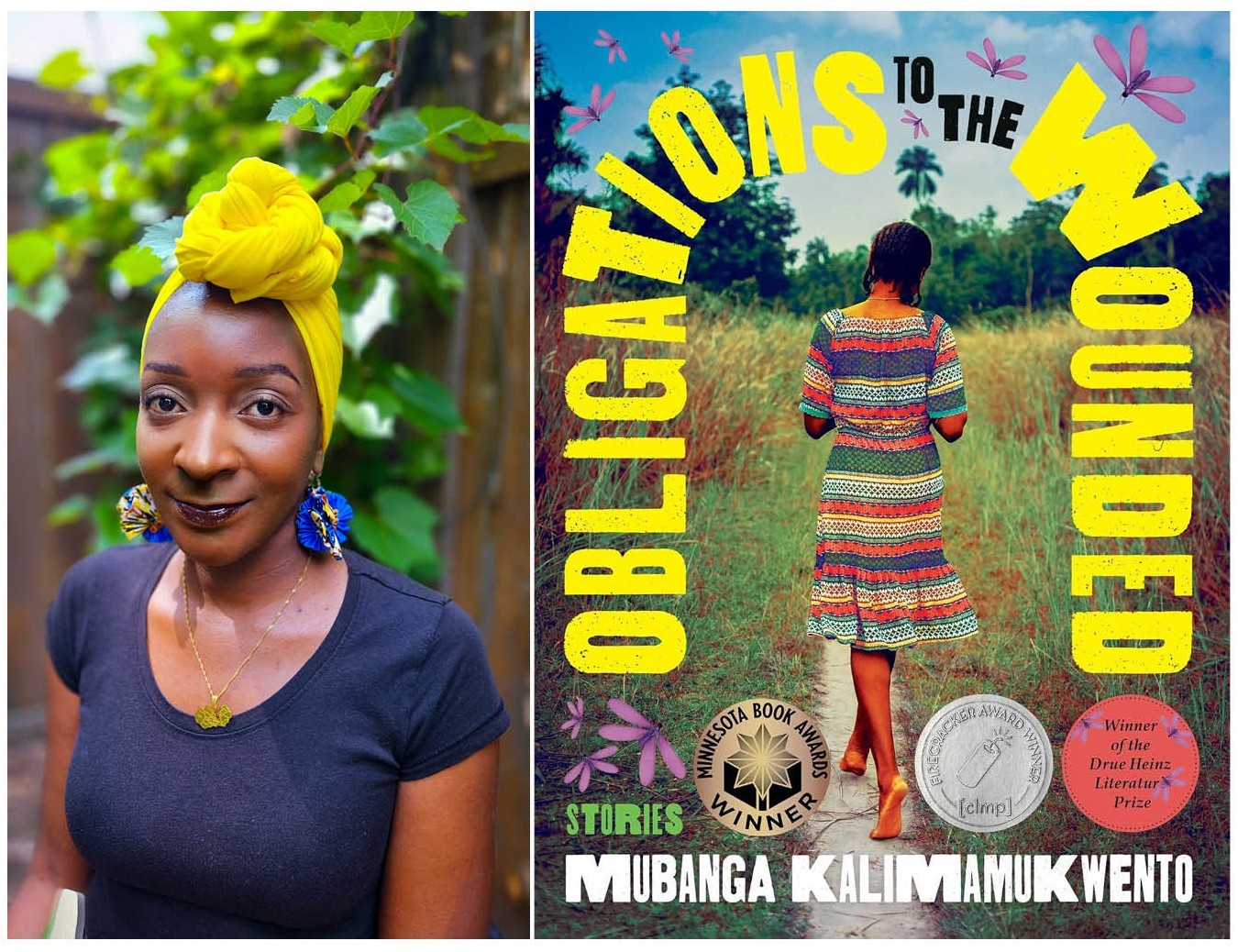
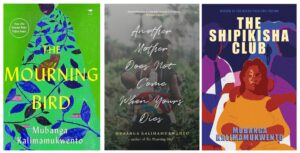
Mubanga Kalimamukwento is the author of The Shipikisha Club (Dzanc, 2026) Obligations to the Wounded (University of Pittsburgh Press, 2024), Another Mother Does Not Come When Yours Dies (Wayfarer, 2025), unmarked graves Tusculum, 2022), and The Mourning Bird (Jacana, 2019). Her work appears in adda, Overland, Isele, Kweli, Netflix, and elsewhere. She has edited for Shenandoah, the Water~Stone Review, Doek!, and Safundi, and mentors at the Minnesota Prison Writing Workshop. Mubanga founded Ubwali Literary Magazine. She is a PhD student in the department of Gender, Women and Sexualities Studies with a minor in Development Studies and Social Change at the University of Minnesota, where she researches Zambian married women who are long-term survivors of HIV.
TJ Benson is a Nigerian writer and visual artist whose work explores the body in the context of memory, Non-Abrahamic spirituality, migration, utopia and the unconscious self. His work has been exhibited and published in several journals and his Saraba Manuscript Prize shortlisted Africanfuturist collection of short stories We Won’t Fade into Darkness was published by Parresia in 2018. His debut novel The Madhouse was published in 2021 by Masobe Books and Penguin Random House SA and his second novel People Live Here was published in June 2022. His characters are often at the margins of the society, finding home in ‘supernature’, that elevated experience of the natural as supernatural as a consequence of being removed from it for too long. He has facilitated writing workshops, more recently teaching a class on magical realism and surrealism within the context of African literature for Lolwe and an Inkubator workshop for Short Story Day Africa. He has attended residencies in Ebedi Nigeria, Moniack Mhor Scotland, Art Omi New York and LOATAD Ghana where he was an African Union writer-in-residence. He is a University of Iowa International Writing Program Spring Fellow, a recipient of the 2022 Prince Claus Seed Fund, the Sudkulturfond Switzerland and shortlistee of the Miles Morland Foundation Scholarship.
Interview
TJ Benson: I’ve been thinking about the way “place” shows up in Obligations for the Wounded, not just in the forward and backward movement of your brilliantly written characters between the US and Zambia. I am interested in the tension between physical versus psychological locations in the book; a lot of the characters experience their narratives in their heads but then we have our narrator in Inswa, whose narrative unfolds in the vividly described Mutengo village. How did you think about place when conceptualizing these stories?
Mubanga Kalimamukwento: So much about this collection was accidental. Which is to say that I didn’t set out to write a collection, for there to be links between one story and the next, or for the line to be drawn so clearly between the US and Zambia. That happened at the end, when the collection felt complete. Actually, it was only when I was arranging the stories that I saw the distinctness of place in the stories. The way the stories came was probably because of the moment in time in my life. “Inswa” was the very first short story I wrote. The year was 2018, and I was very aware of how much I didn’t know about how to pen a story, so there was a lot of researching the how-to’s of the story itself. Because of that, the story itself felt most laborious to me, like a difficult child, so I am not as fond of it as some readers seem to be. This is what I remember about the conceptualization of place in that one: though, once I knew the protagonist, the portion of her life she would be sharing, I knew it was important that she be painted as clearly as possible. An easy option would have been to place her in 2018 Zambia, which I had just left a few months prior, but I knew that would cloud her story with the influences of the time, like the dominance of western media. I didn’t want that. She didn’t want that. So we travelled back together to a different moment in time, where her sexual exploration—even discovery—could be just that.
TJ: “Inswa” also happens in the word, which wouldn’t conjure pleasure and excitement in its English translation, but it does in the story. Its pronunciation also lends itself to this pleasure and excitement, and because the narrator visits this place, her life will change. What can you share about taking the character, into this place.
MK: Your question is more exciting than how I came to the title. All of my stories, including “Inswa” start as questions. The question in here was, “What does a first kiss feel like?” Beyond my own recollections, I looked up how others described that moment. The first experience I read described the known, butterflies in the stomach, which I didn’t like because it didn’t tell me anything new. As the story unfolded, I started thinking about how she might have described this moment, having never encountered this phrase “butterflies in the stomach,” and made myself think about what would be available to her on the sensory level to describe this moment and landed on “Inswa.” It was fall in Minnesota when I was writing the story, which would mean it was the rainy season in Zambia, when “Inswa” come out, so the nostalgia fed into that too.
TJ: In “Azubah,” you go against conventions of formatting prose fiction, instead of paragraphs, we have verses, and several lines start without capitalization. By page two, I dropped the book and started clapping at how successful your style was in bringing Funso’s voice and predicament closer to the reader. How did you craft this form for the story?
MK: T.J., you flatter! I wrote “Azubah” while I was taking a poetry class because it was a required class, but I wasn’t enjoying the creative stretch from fiction, with which I was already comfortable. My poetry professor often said, “I just need you to learn the rules. Afterward, you can break them however you want.” After that class, I’d go to a fiction workshop class where the professor there entreated us to trust one another and treat the workshop space as one where the author shared themselves with us. We were to ask questions, rather than necessarily provide suggestions, based on the assumption that the writer had an intimacy with the story that we, as outsiders, did not have. The combination of those two classes led me to “Azubah,” perhaps a manifestation of the fragmentation I was feeling moving between classes and genres.
TJ: I really enjoyed how your experience in other genres were working into these stories. It is popular to adopt postmodernist experimentation for flair, but when you do it in stories like your “#Baileylies,” it gestures the reader towards the world you are building and the characters populating them. Throughout the story, I was lifted from the traditional suspense reading a thrilling book can give and dropped into the anxiety ridden chaos and frenzy of social media spaces, and right at the end, I felt the abruptness right alongside the narrator. How did you craft the form of this story, which is so dependent on the digital platform its narrative plays out?
MK: In my second year, I took a class taught by Brian Malloy called “Emotional Range.” The loose premise of the syllabus was that most writers in MFA programs do not struggle to write strife, but that, since a reader is meeting characters for the first time, they may not always be invested in those perilous emotional journeys unless they are introduced through an emotion a bit lighter to carry, like humor. I think this is similar to making a friend. Most times, at least for me, those first interactions are lighthearted, some traumatic lore dropped from time to time, and admittedly, sometimes that can happen quickly, but I’m talking here about that first interaction, maybe even the first five minutes, while we figure each other out.
As a writing companion in Brian’s class, we studied John Boyne’s The Heart’s Invisible Furies, a novel spanning several decades and starting in the 1940s. The story traverses the stigma of HIV diagnosis for gay men in Ireland across time, which, as you would expect, is an emotionally taxing task for the reader. But as we read, Brian constantly pointed out the quiet humor, even amid the horror. He tasked us to write stories that tried to do similar things and gave us prompts that would encourage us to write something brand new, and not just pull from what we had on our laptops. I wrote “#BaileyLies” in response to a prompt to write a short piece about a disgraced memoirist. I think I had just given up Twitter for the second time then and was thinking about the things I loved about being online—how we can feel connected with one another (kind of like how I recognized you at AWP based on prior engagement with your content online), but also how echoey and chaotic it can be.
TJ: We see you use this style in “Do Not Hate Me,” but steered in a different direction, using the eerie plural voice of “we,” beings that mediate and interfere with Msanide’s life. It is such a short story, but it is thick with this call and response relationship that weaves its way through the narrative and there is the commentary on the tension between Western conception of psychosis and African spirituality. How did you begin to work through these themes in the story?
MK: “Thick” is so apt a description of my experience of writing “Do Not Hate Me.” Someone wiser than I said that all fiction comes from fact, which I think means that stories begin here, in the physical, before our imaginations take them elsewhere. This story started before I turned five, in a recurring dream that my mother insisted was just a dream. It would be another five or six years before that dream climbed out of my mind to show itself here, in the physical. By then, the only witness was me. If I recounted it, I’d have been called mad, which, aged elevn seemed more frightening than it does now. Anyway, that dream from three decades ago is why I don’t let myself forget my dreams—even if they turn out to be just that, I keep stock of what my mind is doing while I am asleep. I was raised Christian. In that belief system, a dream such as we see in “Do Not Hate Me” would be called a prophecy. But Christianity is not the sole guard to that moral system. It’s braided with other epistemologies from the various ethnic groups in the country (I belong to three). I have always found that marriage between the Abrahamic religion and the Zambian wisdoms interesting. In this story, the question I am teasing is this duality, suggesting alternative ways of approaching what it means to know, to foretell, to fear.
TJ: The voices of your narrators are often contemporary, yet each story is preceded with proverbs from different tribes. Cultural Proverbs aren’t used as often by young people in my experience, so I am fascinated by and curious of your choice to offer these proverbs to meet contemporary lives.
MK: I disagree with the idea that proverbs aren’t so present in the lives of young people. Perhaps I am ageing myself here too. Anyway, I have re-fallen so in love with proverbs, how they are both the preamble and the story itself, the way the meaning is so fluid but somehow solid too. When we would have story time in primary school, some of my classmates used them as anchor and sometimes as the story itself. I think they are all around us, proverbs, even the kind used in the collection, but maybe because the words may have changed, we don’t recognize them as such. It’s possible too, that as my children grow older, and that their aging can feel like a distance forming between parent and child, that I find myself trying to give these wisdoms in small containers so that I don’t fall into the cliché of the mom who gives a ten minute soliloquy and then says “but anyway, I won’t say much.” And also, if I am being honest with myself, some of it comes from nostalgia, an affection for homeland that stems from absence.
TJ: Lastly, as a writer myself, I am always curious about endings. You end the stories in Obligations to the Wounded in a plethora of styles, how do you find your endings or how do they find you?
MK: As a writer yourself, you know that the answer will be that I just know when the story is done telling me what it needs to. I revise a lot of things in stories, especially for the collection, where some of them had been published before, but I do very little to change the endings. It is like death in that way, when it comes, it comes.