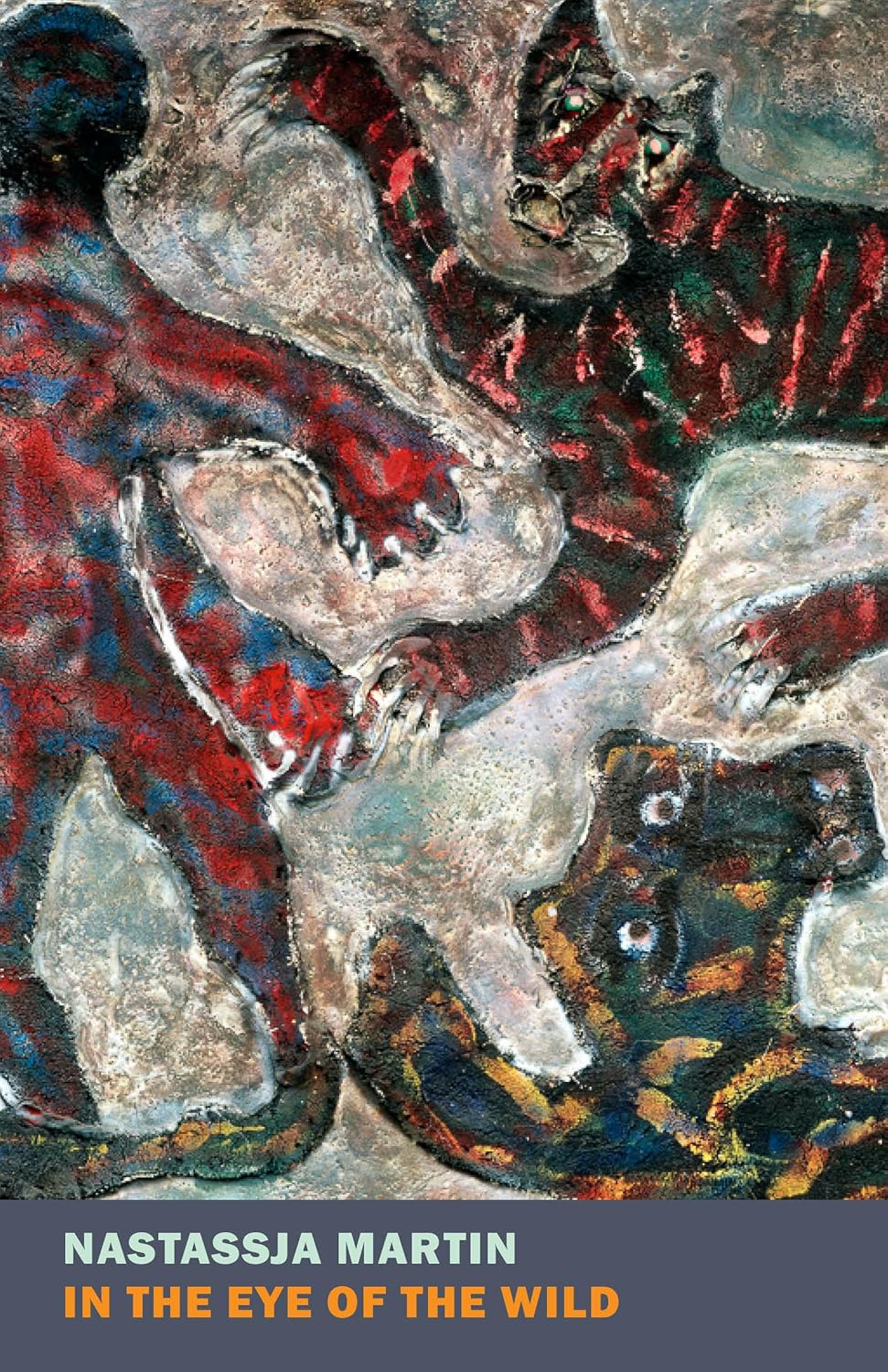

          Kat Jackson | Review of Nastassja Martin, In the Eye of the Wild. Translated
          by Sophie Lewis (New York Review Books, 2019).
French anthropologist Nastassja Martin’s In the Eye of the Wild (2019) opens as she is medevacked out of the Siberian wilderness, shortly after she narrowly survived a bear mauling. The encounter leaves her physically disfigured, but it also initiates a profound spiritual metamorphosis in which boundaries collapse and familiar binaries fall away.
Before the attack, Martin had been living and working in the forests of Kamchatka, a peninsula off the northeast corner of Russia, while researching the Evens people indigenous to that region. Even culture is deeply shaped by their reliance on and embedment within the landscape, and their belief system accounts for events such as animal attacks. These encounters are understood not only as devastating traumas but also as inherently transformative moments and opportunities for intellectual and spiritual revelation. In a moment that encapsulates the way Even beliefs shape Martin’s recovery from this event, she describes her reunion with an informant in this community as follows:
          He says: Nastya, have you forgiven the bear?... You must forgive the bear.
          I don’t reply straightaway; I know I have no choice, and yet for once I want
          to disobey, to reject fate, our bonds, to reject everything we move towards
          that is inexorable, I want to shout that I wish I had killed him, to expel
          him from my system, that I am so angry he has disfigured me like this. But
          I don’t, I say nothing. I breathe. Yes. I have forgiven the bear. (p. 19)
This book serves both as an ethnography of the Evens people and as a surreal philosophical reflection on the transformation that unfolds as Martin works to make sense of herself and the world she inhabits after the encounter. Through this near-fatal moment, In the Eye of the Wild permeates the boundaries that define the human, challenges the limits of Western epistemology, and grounds a new poetics of trauma and metamorphosis in animistic sensibilities.
The Evens people consider those marked by a bear medka (male) or matuhka (female), meaning they are understood as half bear, half human. In this worldview, a matuhka occupies a space between material reality and interspecies dreaming. Because Martin has spent years immersed in the Evens’ cosmology, she is able to interpret her encounter with the bear outside standard Western binaries that separate humans from nature. As she writes, “The bear and I speak of liminality, and even if this is terrifying, no one can change that… I mean to stay in this no-man’s-land (p. 80).” What this encounter reveals to her is the inherent permeability between the human world and the more-than-human one. Rather than imagining the human subject as superimposed on a nonhuman landscape, as mere backdrop, Martin’s experience becomes evidence that humans are deeply and inextricably embedded within their ecosystems. With this realization, ontological and metaphysical boundaries begin to blur. As Martin states, “…the borders between ourselves and the outside world dissolve, little by little, as if we were gradually disintegrating and sinking into the depths of oneiric time where nothing is settled, where the boundaries between living beings are still in flux (p. 88).” Here, not only does the human/animal binary collapse, but other Western dichotomies (culture/nature, subject/object, etc.) also begin to fall away, no longer able to neatly contain or explain the world as Martin now experiences it.
Martin writes with this blend of ethnography, memoir, and philosophical treatise because the encounter with the bear stripped Martin of the traditional subject/object and self/other separation between herself and the culture that she was studying. She could no longer move through the world or her research simply as an anthropologist; the bear transforms her into an active participant in the fabric of Kamchatka’s ecosystem. In dreams, “The bear’s body and [Martin’s] are vaguely merging, [her] skin mingles with his thick fur (p. 84),” and between reconstructive surgeries, Martin reflects that, “The bear carried off a bit of [her] jaw and two of [her] teeth in its mouth… [She] was the one who walked like a wild thing along the spine of the world – and he is the one [she] found (p. 50).” Given this profound entanglement, it is no surprise that Martin’s psychological healing involves returning to the forests of Kamchatka to live among the people who can see her as she now is—a matuhka who has experienced “the interpermeability of two souls, the tanglement of ontologies (p. 84),” and who therefore carries a piece of the bear within her.
As such, Martin’s training as a Western scholar offers an insufficient framework for interpreting her trauma and transformation. The bear exposes the inadequacy of scholarship’s detached, extractive mode of knowledge-making. In its place, Martin must become embedded within the landscape and its cultures. It is her use of reflexive methods, rather than extractive ones, which allows her to remain aware of her position as an outsider within the Evens community. She is not a distant observer projecting her own values or rationales onto the belief systems and lifeways she encounters in the Siberian forests. Instead, she learns respectfully and without appropriation because she allows the break in binaries between Western and Indigenous epistemologies to remain open, committing herself wholeheartedly to understanding how the Evens relate to their environment with genuine curiosity and humility. Because of this, the bear encounter is not framed as a random, masculinist act of violence. Rather, the bear becomes a teacher, offering Martin the opportunity to deepen her understanding of herself and the world she inhabits. In this sense, Martin allows herself to be changed by Indigenous ways of knowing.
By recontextualizing her worldview and allowing herself to become embedded within the Evens’ belief system, Martin transforms her trauma, both physical and emotional, into a site of knowledge. Her body, with its wayward teeth and the chunk of jaw carried off in the bear’s belly, becomes a permanent marker of the permeable boundary between self and other, the orderly and the wild. Martin writes, “…our bodies were commingled, there was that incomprehensible us, that us which I confusedly sense comes from a very distant place, from a before situated far outside of our limited existences (p. 59).” This collision between human and more-than-human takes on a quality that exceeds ordinary reality, aligning with the Evens’ belief that a matuhka has crossed a liminal veil between worlds and returned irrevocably marked by the bear encountered in that in-between space. That mark becomes a source of embodied knowledge. Without the interpretive framework provided by the Evens, Martin may not have understood the encounter in these terms or emerged from her trauma with such a deepened sense of the world.
Martin’s encounter with the bear ultimately collapses the familiar Western notion that humans exist apart from their environment. In the Eye of the Wild participates in broader conversations within animist and anti-dualist thought, echoing multi-species theorists such as Donna Haraway, Robin Wall Kimmerer, and Anna Tsing, emphasizing the embedded, relational, and co-constitutive nature of knowledge. Martin challenges Western epistemologies that prioritize separation and mastery, instead centering Indigenous ways of knowing that foreground reciprocity, permeability, and relational knowing. In tracing the aftermath of her life-altering encounter, she demonstrates how surviving an encounter of this magnitude requires the dissolution of familiar binaries such as human/animal, self/other, and culture/nature and invites readers to consider what becomes possible when those boundaries give way.
Kat Jackson is originally from Wyoming, though she lived in Western Montana while earning a BA in English and an MA in Environmental Philosophy from the University of Montana. With a background in nonprofit work and social services, her writing explores the intersections of ecology, identity, and the uncanny. She currently lives in Iowa with her two cats, Louisa and Dorothy, where she is pursuing dual master’s degrees in Creative Writing and the Environment and Anthropology.