
“One day, as I went out to my wood pile, or rather
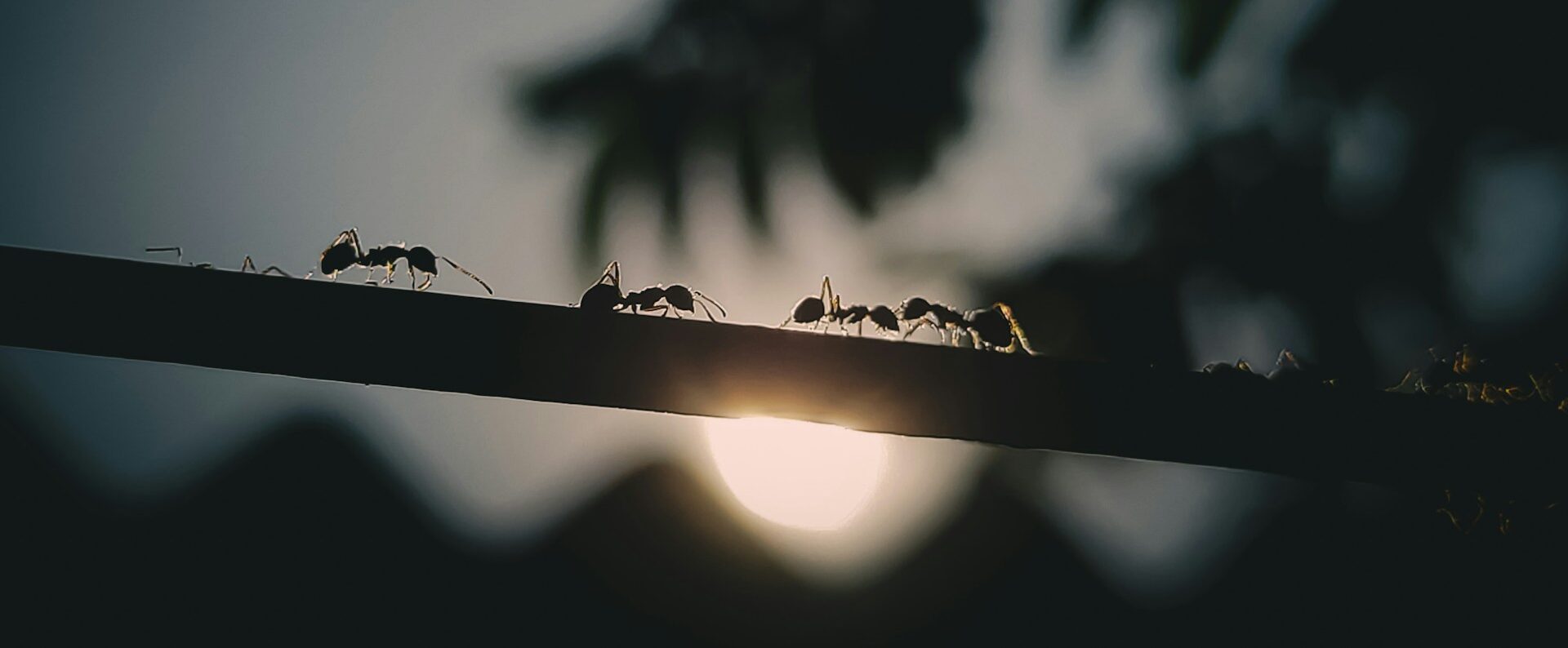
my pile of stumps, I observed two large ants…” [1]
Before I cried uncle and moved to a worn-out city by a river, I lived in a one-bedroom subprime mortgage in Los Angeles. It stood tiptoe on a Verdugo foothill gazing at the San Gabriel mountains. Those burn a lot, and sometimes my friend, Bess and I would lounge on my redwood deck and watch the lingering fires like they were television. Low-flying helicopters buzzed the peaks, dropping their portable mini-floods of PFAS, which we probably lactated a couple years later when the babies came. Bess called me the day after Trump’s second election, still a little drunk and said, “Maybe we were doomed, even back then, and we didn’t know it.”
But in 2002, there was Two-Buck Chuck at Trader Joe’s that was surprisingly drinkable, and two-buck interest rates on loans they would give to almost anyone, even underemployed losers like us. While I was living in that house, before the variable-rate even varied, Obama was elected, and we stood enchanted in front of the inauguration broadcast, watching him dance with Michelle at the ball. Everything was working out!
We were, however, really annoyed about the damn ants.
They’re everywhere, everywhere! our neighbors said to each other. None of us grew up with ants like these back in Georgia or Lahore or Minnesota or the 1980’s. They were the tiniest ants any of us had ever seen and even as a species famous for their multitude, they were legion.
One early morning, in the June gloom of the kitchen, I couldn’t see them, but I felt a busy presence all around me. Even after I flipped on the light, I had to look for them, but once I did, it was hard to understand how I’d missed them. Their lively black river flowed all over the room before disappearing impossibly under the white folded seal of the freezer section door. I opened it and gazed down, trancelike, at about a pint of frozen ants piled on the ice cube trays. I watched the marching line continue to terminate on top of the mortuary pile, ants running forward, then slowing, then freezing, then dying.
I turned around in that frosting air and scanned the room. That’s when I realized it wasn’t just one river. That’s when I saw the tributaries and streams and watersheds, the great confluences materializing on the counter, on every wall, the ceiling, streaming out of the kitchen and underneath the bedroom door.
They began to make a sound then. It was a rising guttural sound full of grief and horror. I had not known ants could vocalize like this. Then I realized: the sound wasn’t coming from them. It was coming from me.
“I took up the chip on which the three I have
particularly described were struggling, carried it
into my house, and placed it under a tumbler on my
window-sill, in order to see the issue.”
The oldest video on the Anthill Art YouTube channel is from 2013. It has 172 million views. There’s no narration, no explanation, just the title itself: “Casting an Ant Colony on a Log with Aluminum.”
It’s nighttime, for some reason. It’s dark. There is a shot of an anthill in the grass. A smoking metal bucket lowers into the frame and what looks like melted quarters pours out, disappearing into the nest entrance. When the bucket is empty, it raises back up out of frame. For a few moments, we watch smoke rise from the hill, steaming like a teakettle. After a cut, a gloved hand slowly excavates the anthill with a spade. The “sculpture” is eventually extricated from the ground where it was nestled up against an underground log. It is lifted: up, out. So much red earth clings to it that there is only a small glint poking through here and there.
A third shot shows the cast—still outside, still nighttime—secured with bungee cords and power washed, slowly revealing the spectacular shape of the ant colony, with its treelike branching, its rhythmic, spiraling tunnels rendered in dull silver.
The final shot is inside, somewhere, some gallery-like void. There is maybe a black velvet background hung behind it, and it is displayed on a small rotating platform. A hand turns it around and then the video freezes. A large red circle with an arrow appears on the side of the cast. It reads, “The log was here.”
The extended comment section is divided into three camps. One just says the sculpture looks cool and the process is clever. A smaller one questions the cruelty or destructiveness of the act. And then there is one that exults in the vanquish of ants because “have you ever been stung by a fire ant, they are evil.”
“Looking farther, I was surprised to find that the
chips were covered with such combatants…”
Trey was the most hyper kid in our first-grade class, but right now he was frozen, his softball glove drooping. I had never seen him stand still before.
“What’s wrong?” I said, “Throw it.”
Just then I was distracted by a red-shouldered hawk who glided into my vision overhead, mobbed by jays. The smaller birds wheeled and dove at the raptor’s head in coordinated attacks. The first time I had witnessed this phenomenon, I felt protective of the hawk. Why were those birds being so mean to the pretty big bird? My big sister explained that the jays were mother jays protecting their nests from the predator. I let my own glove drop and tilted my head up to watch their maternal heroism, which always heartened me.
By the time I looked back at Trey, he was standing further away, staring at my right foot. I followed his gaze down. My white gym sock looked rusty, and it was churning, alive. My hard consideration of this mystery forestalled fear for an instant, in which I heard Trey whisper the answer.
“Fire ants.”
I looked at him, then back down. My sneaker was planted into a neat cone of red sand that blended perfectly with Georgia clay. Then I felt the first sting. Trey ran.
Later that night, woozy with Benadryl, I said, “I hate them, I hate them, why did they do this to me?” My own mother jay shrugged.
“Your big old foot smashed down on their house.”
“They fought with more pertinacity than bull-dogs.”
As a mother, I was in it to win it. The books, the sign language, the constant conversation and engagement and the nagging worry that it would never be enough. Were there field trips to botanical gardens and museums? There were. Sensory investigation of art materials? Yes. Was the library a fetishized palace of knowledge and fun? It was, goddamn it. Were the butterfly cocoons ordered and ensconced in their home habitats and were they celebrated when they hatched, then liberated with pomp? Check, check, check. Yes, of course there was an ant farm.
It was filled with green plastic silhouettes of a barn, a silo and a farmhouse. The ants arrived a week later, big black carpenters, fresh from their postal adventure. After we popped the vial in the fridge for a few minutes to slow them down, my three-year-old daughter tapped the woozy new agronomists inside. She knelt before them to sing, for several hours, an unnerving song of welcome, something like: “Ants, ants, you live in glass now.” Despite this, the ants settled in and thrived. They lived on the windowsill in benign neglect for almost a year. Then one day we came home to find them under attack.
The tiny ants were marching in single file from under the front door again, taking a right turn into my daughter’s bedroom, and making a bee line for the windowsill. Inside the farm an incredible drama was unfolding. It was a struggle for the tiny ants to penetrate the tight seams of the ant farm, but as soon as one managed to wriggle inside it would instantly charge one of the nine big carpenter ants.
We weren’t worried. Our big ants dispatched with the first stray invaders with ease, just swatted them down. No big deal. They were so much bigger than the local ants, and it was hard not to think of them as more sober and wiser than the dumb hordes who had accidentally killed themselves in my freezer a few years before. For the most part, the little ants were only throwing themselves unprofitably against the glass, unable to get inside.
Until they were. All at once, dozens of the invaders popped inside the glass and began dismembering our guys. My daughter goggled her eyes up at me.
“Are they going to be okay?”
I hovered above her wondering whether this was traumatizing or educational and then wondering what the difference was. I picked up the farm to…help? Somehow? But she grabbed it back from me, the heartless little bloodthirsty thing.
“Let them fight, Mama. They want to fight so let them fight.”
“Well, take them to the deck to watch, then.”
She took them outside and the line of ants slowly bent back on itself to follow. I tied up my apron and started cooking dinner. Ten minutes later, she walked back inside.
“They died. I’m hungry.”
Ant farm. Nature. Check.
“Why do precisely these objects which we behold
make a world? Why has man just these species of
animals for his neighbors; as if nothing but a mouse
could have filled this crevice?”
The morning after the ant farm war, my daughter helped me dump the carpenter corpses in the yard. I put my arm around her and asked her if she wanted to say a few words about them and the lives they had lived. “Do we have to?” she said, yawning.
Soon after, she fell asleep in my lap and to pass the time, I googled. What I read was captivating. I was entr-ant-ced. I learned that Linepithema humile is an ant species known to have hopped a cargo ship from Argentina in 1891, landing them in New Orleans. Several years later, they used trains to migrate to Southern California where, over the course of a century, they decimated and replaced most of the 300 native ant species.
Around the time the Argentine ants first showed up in my kitchen, scientists were just beginning to understand that they were able to do all this because of their unique ability to form supercolonies, vast networks of genetically identical ants that can work together across large areas. Ruthlessly hostile to other species and strictly loyal within, these little things are almost unstoppable. In the early aughts, researchers were breathlessly publishing reports of one vast ant colony that stretched from Santa Barbara all the way down to the Mexican border and beyond. Today, most agree that the supercolonies are much bigger, and span continents. These colonies cooperate, share workers, and have minimal territorial disputes with each other due to their genetic homogeneity. One of the largest known supercolonies stretches from Italy to California—a span of over 3700 miles. Which includes the Atlantic Ocean.
Italy to California. I thought we lived in little house on a hill, but the camera pulled back and back and back and oops, we were squatting on a molecule that clung to the edge of Antopia. This is an ant’s world. We were just living in it. Inside a predatory loan from the Wells Fargo global supercolony.
“I was myself excited somewhat even as if they had been men.”
Years later, I had not forgotten about these ant encounters but had certainly stopped thinking about them. I no longer lived in L.A., and anyone who has moved from that place will tell you how quickly it takes on an aspect of myth. I had digested a divorce and changed careers. I lived in an old brick building that had been built around the time the ants had disembarked from Argentina. My daughter was older now and filled with bewildering complexities. Hilary Clinton was about to become the first woman president. Times had changed. But one day, I started the car, and it filled with a Radiolab rerun already in progress. Robert Krulwich and Jad Abumrad were interviewing Argentine ant researcher, Neil Tsutsui:
     JAD ABUMRAD: So here you've got this monoculture, right?

     ROBERT KRULWICH: Mm-hmm.

     JAD ABUMRAD: That's violent, on the edge.

     ROBERT KRULWICH: On the edges. Yeah.

     JAD ABUMRAD: But then if you're on the inside and part of the group, very, very peaceful.

     ROBERT KRULWICH: And since there's only one other creature that can do this, that can
          create an allegiance across vast, vast spreads of Earth, I couldn't help but ask Neil…

     ROBERT KRULWICH: Do you ever analogize to human history when you look at these things?

     NEIL TSUTSUI: It's tempting to, but I try not to. Because these sorts of situations are kind
          of a Rorschach. You can see whatever you want to in them.

     ROBERT KRULWICH: Yeah.

     NEIL TSUTSUI: And so, you know, for our Argentine ant research, we've had people say, "Look,
          the lesson from this is that we should all be like Argentine ants and get along and cooperate
          and we'll succeed." But then on the other hand, I've had white supremacist websites cite my
          research and say this is evidence that the key to success is not mixing the races [2].
“Once I was surprised to see a cat walking along the stony shore of the pond for they
rarely wander so far from home. The surprise was mutual.”
I’m trying to walk in the woods. I’m just trying to walk in the woods, wishing to live deliberately and all that, fronting only the essential facts of life, if only for a suburban hour. Night is falling. The light is leeching out of the world and I’m cold. I’m thinking how I wish I could just go on a fucking hike in, like, real nature, without having to listen to the distant sounds of the freeway even in the middle of a forest. I’m wondering how far you have to go from people to escape that sound completely and is there even a place that remote left in the contiguous United States?
I consider taking out my phone and doing a search on that and maybe also on whether I am using the word “contiguous” correctly. But then I remember I promised myself not to look at it during this one walk. Really, I should have left it in the car, but I had decided to bring it along for safety because it’s twilight and I’m a woman alone in the woods and bringing the phone was supposed to be my one concession to that fear. I’m quite passionately wishing I was not thinking about my phone right now, all the pathetic rules I must have for myself about it. Because really, aren’t the rules and the constant self-reproach about the phone and how stupid it is making me, isn’t that just as bad as the phone itself? Doesn’t it—isn’t it, right this very moment in this beautiful liminal miracle of a winter sundown actually keeping me from Living Deliberately anyway? I decide I’ll just take out my phone for a tiny second and make a note to google that stuff later when the hike is over. That will do the trick. After that I will breathe in deeply and finally arrive. Just as I am drawing it out of my pocket, I realize that an enormous deer is standing only two feet to my left and I have locked eyes with it.
And I understand that by the time you ever lay eyes on a deer in the woods, it has already been watching you for a long time. It’s startling and weirdly humiliating, like looking up from the toilet in a public bathroom stall and seeing a security camera.
But as far as stopping the chatter in your head, it really gets the job done.
“I felt for the rest of that day as if I had had my
feelings excited and harrowed by witnessing the
struggle, the ferocity and carnage, of a human
battle before my door.”
Somewhere above your head, the aluminum lava has been flowing down into your nest, and it is just now reaching you. Wild animals are observing you fumbling with your phone from afar. The place where you planted your young feet is a trap. There is the sudden apprehension of a vast presence underfoot finally making itself known. A presence that has been there for a long time, quietly changing everything, eliminating rivals, hollowing tunnels in the earth for a hundred years before you even knew they were there.
“Maybe we were doomed, even back then, and we didn’t know it.”
I didn’t get much sleep on election night, either, so I’m irritated with Bess when she calls the next morning. I want to ask her what’s the point of talking about it now. I don’t like her slurring. I want to tell her shut up, stop crying, you drink too much. But I drink too much. I look at my phone too much. I sleep too much, consume too much, watch too much tv. My God, I’m so disgusted with both of us, all of us.
“I have to go.”
“We should have paid better attention,” I hear her say as I hang up the phone.
Around that time, in St. Louis where I now live, swastikas hung from the highway overpass, snapping over the morning rush. A line of men all in black, their faces masked. I feel the tiny legs on my skin. I feel the first sting. I want to resist easy analogies, as I have been warned. After all, what do these men with their loathsome cosplay, these dim LARPers have to do with the ants, who are only doing what ants do, who are only doing anting? Let the ants be ants and not men. Let whatever is watching us from the woods right now make itself known.
Nancy Bell lives in St. Louis, Missouri, where she writes, makes theatre, and teaches at St. Louis University. Her work appears or is forthcoming in StoryQuarterly, Terrain, North American Review, Shenandoah and elsewhere. She holds an MFA in acting and directing from California State University at Long Beach and is working on a second one in creative writing at Mississippi University for Women. She is friendly with trees and while she respects insects, she doesn’t want them on her.
Notes
[1] All heading quotes from “Brute Neighbors” in Walden by Henry David Thoreau
[2] “Argentine Invasion.” Radiolab, hosted by Jad Abumrad and Robert Krulwich, WNYC Studios, 30 July 2012,