
          Micaela Edelson | Daisy Atterbury’s The Kármán Line: Traversing the Boundary
          Between Space and Belonging (Rescue Press, 2014).
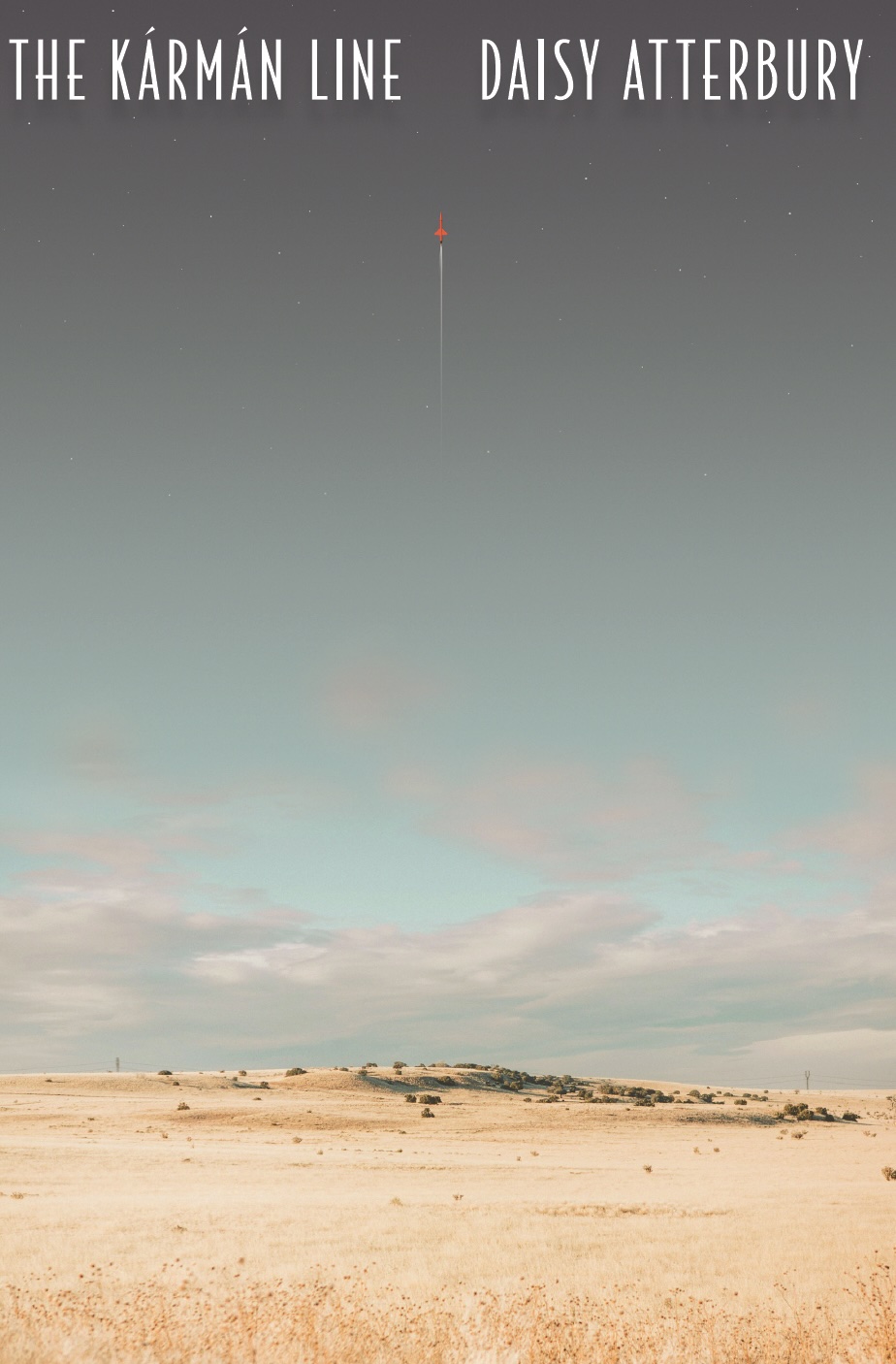
Daisy Atterbury’s The Kármán Line is a lyrical prose book about space—outer space, the space that bodies hold, the space that other bodies claim, the spaces that are claimed, constructed, or colonized through words and histories. The Kármán Line is the physical boundary between earth and space, but it is not exclusively the universe that Atterbury explores.
Atterbury begins the book with a list of places (in no particular order), which are later contextualized as spaces that backdrop the exploratory narrative, i.e. the European Space Agency and Jiffy Lube, White Sands Missile Range and Tinder. Subsequently, the first chapter, “after star death,” is an anomaly from the rest of the structured book, which is organized along layers of the atmospheres (troposphere through exosphere). In this first chapter, Atterbury offers the blueprint for how the book should be read. While the first sub-heading in the first chapter is the titular Kármán Line, the first paragraph, the first sentence!, collates “after star death” to a collapsed relationship, “No love deserves the death it has.” The reader knows from the beginning that this book traverses the boundaries between earth and space along unexpected and intimate ways, traveling from the vast exterior toward interiority to reflect on gender, love, belonging, conquest, and dominion. addressing the second-person you, as an elegy to their ex-lover.
Subsequently, the atmospheric layers structure the rest of the book; however, another scale operates between the body, the nation-state, the earth, and the broader universe—all scaling up from micro to macro, from cell to space. This structure, like the title, and braided scientific queries, histories, and explorations, almost present this book to be more about our scientific connotations of space, exploring the scientific concepts behind the Kármán line, Zones of Avoidance, binary asteroids, Spaceport America, and the impacts of the Manhattan Project, among other examined terminologies and processes. However, as the book progresses, the sub-headings and content shift to the more abstracted reflections that Atterbury undertakes, connecting scientific reflections with Atterbury’s own experience of living as a queer millennial and experiencing heartbreak. The question of belonging (in space, society, body, and otherwise) is the central theme in The Kármán Line.
The narrative through line, perhaps, is the following of Atterbury as they visit Spaceport America, an active space testing facility in the New Mexico desert. Not only did Atterbury grow up nearby and experience the direct and indirect environmental consequences of space travel, but also, their lost love is employed at Spaceport America in space flight testing. This journey to Spaceport America culminates in the final two chapters, but the relative importance of the site is weighed throughout, intertwining reflections on humanity’s relationship to space but also reflections on individual relations to others, collapsing the hierarchies of being once again.
Atterbury also reckons with science’s muddled past, for example, how nuclear testing in Indigenous communities and environmental health consequences of uranium mining portend a pattern that might but all be repeated as we look to conquest outer space. They position their own histories within the recurring theme of space domination as a child near uranium mining sites and as the grandchild of French immigrants fleeing Nazi Germany. The Kármán line is the partition where ownership over nation-state cannot be claimed. “It marks the end of national boundaries and the beginning of what is known as free space” (151). It is this statement in the final chapter that contextualizes the weight of the titular boundary. Here, Atterbury is free from the constraints of earthly impositions—impositions as colonial and environmental domination, but also as cultural expectations and queer belonging in the body.
While the primary operating genre is prose, Atterbury integrates personal poetry, touching on themes of identity and desire, throughout. Though at times the leap between a scientific concept and Atterbury’s interior reflections don’t always hold strong connective tissues, I think such meandering mirrors the sometimes-scattered paths that we travel within mind (and life), blasting off from one mental journey toward another. Regardless, the poetry is highly emotive, infusing sentiment in the supposed objectivity of science: “I’m in a former seabed, awaiting / the moon’s full funeral rites / I pay bills well into the future / with credit from times of plenty” (78). Atterbury questions the role of emotion in science, critiques the impartial past of a science propelled by power.
Akin to Maggie Nelson’s Argonauts, and Katheryn Savage’s Groundglass, Atterbury’s poetic prose offers more questions than answers, invokes reader reflection instead of proselytizing on cultural issues too vast for simple solutions. Across identity, desire, and institutional and individual interactions with the earth, Atterbury casts their net wide but the threading element of space and belonging ties through. I also found parallels with Samantha Harvey’s Orbital. Though a novel with more structured prose, both books present the existential inquiries that space travel (both mental and physical) invoke. The Kármán Line is for the literary reader, the poet exploring long-form and the memoir reader urging for lyrical language that captures feeling and curiosity over concrete narrative events.
Overall, I recommend The Kármán Line for readers who desire a reflective journey across physical and emotional boundaries. Atterbury artfully critiques the historic and future-forward tasks of boundarying. The questions of belonging, on earth, space, body are not answered but leave the reader with an acceptance for the unanswerable nature of existence and the universe.
Originally from Salem, Oregon, Micaela Edelson previously worked in the environmental policy field before transitioning to creative writer. Micaela is currently finishing her MFA in Creative Writing and the Environment from Iowa State University. www.micaelaedelson.com